
*CLAIM YOUR DISCOUNT:
As the owner of this website, I’ve tracked down special deals for some of the products and services mentioned herein. When you use the links on this page to make a purchase, I may get a small commission, and you may get a great bargain. It’s a win-win all around.
Horse saddle bags. Why do you need them? What kind of horse saddle bag should you buy? What should you put in these horse saddle bags? In this post, I’ll explain the different types of horse saddle bags and what you need to do to avoid overloading your horse with unnecessary things.
Then, depending on the type of excursion you plan on embarking on, I’ll show you a few horse saddle bags that might suit your needs. Keep in mind, that I’ll be specifically talking about Western horse saddle bags.
What are Horse Saddle Bags?
So you’re ready to go on a trail ride. Or, maybe you’re going on a cross-country trip. You’re going to need to pack certain essentials. That’s where horse saddle bags come in. They help you stay safe and secure during your ride by allowing you to pack the things that will make your trip a whole lot easier and even life saving.
Horse saddle bags are storage bags that you attach to your saddle. They allow you to store essentials like cell phones, cameras, light lunches, grooming tools, wound kits, water bottles, and blankets.
Western riders tend to use saddlebags more so than English riders because Western riders tend to go on longer trail rides and need the storage space.
What Materials Are Horse Saddle Bags Made Of?
Traditional materials used in horse saddle bags are cloth, waxed oilskin, and leather.
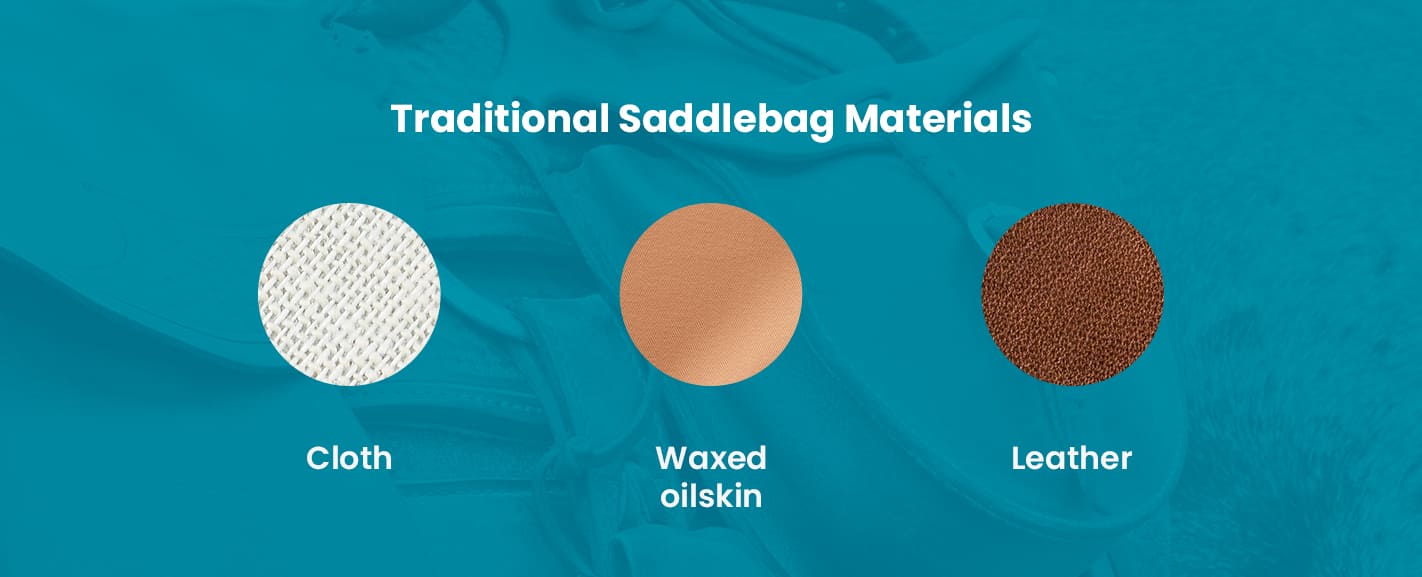
Cloth Saddle Bags: The most common cloth saddle bags come in nylon, cotton and canvas material. Cloth saddle bags have the benefit of having a wider selection of styles and colors. Another benefit of owning a cloth saddle bag is that they’re easy to clean and are lightweight.
The downside to owning a cloth horse saddle bag is that they’re not water or element resistant. They also show wear and tear over an extended period of time.
Waxed Oilskin Saddle Bags: This saddle bag is a better alternative to cloth. Waxed oilskin saddle bags are made of tightly woven cloth treated with oils and wax. They’re lightweight, waterproof and resistant to the harsh elements. Because of the durability of these saddle bags and their treatment, waxed oilskin saddle bags tend to be more expensive than cloth saddle bags.
Leather Saddle Bags: Many people prefer the traditional look of leather saddlebags. Leather saddlebags are durable, hold their shape well and are available in different finishes to match your saddle. They do require more cleaning and upkeep than cloth or waxed oilskin alternatives. Leather used to be the traditional material for horse saddle bags. But leather is heavier. Leather is also higher maintenance than many modern versions.
And much more expensive.
3 Types of Horse Saddle Bags
There are 3 types of horse saddle bags. Each has its advantages and disadvantages. Again, depending on what type of riding you’ll be doing and how long you plan on being on the trail, that’s the kind of saddle bag you’ll choose.
Let’s take a look.
Pommel Bags: The pommel bag hangs in the front of your saddle. Pommel bags come with two medium-sized bags connected with a single, wide piece of fabric. The center fabric allows you to hang the bag over the front of the saddle. Some of them have a hole so that you can slide it over the horn of a Western saddle.
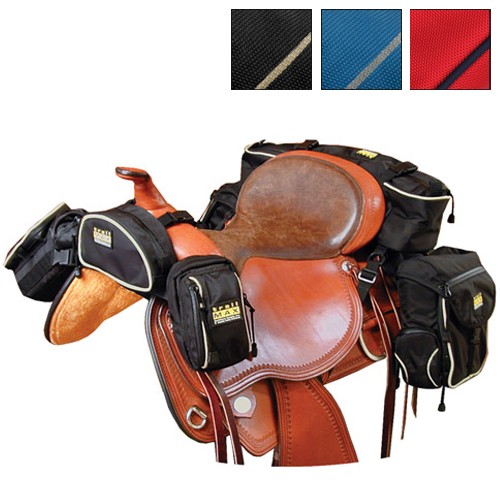
The benefit of using a pommel bag is that it makes it easy to access your water bottle or other must-haves during your ride. The only downside is that sometimes you might feel the saddle bag brush up against your leg.
Traditional Paired Saddlebags: These saddle bags lie on the hips of the horse on either side behind the cantle. These saddle bags function like pommel bags, except they sit at the back of the saddle. They’re great for storing items you don’t need in a pinch. So you’d put your light lunch in it or your mini wound kit.
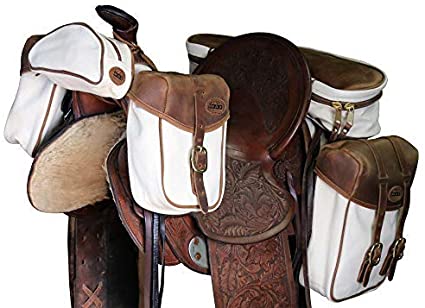
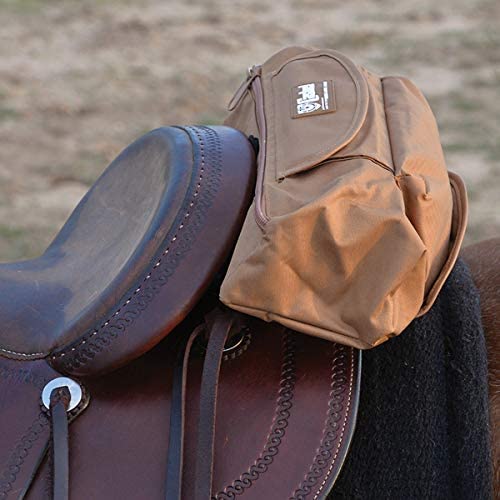
Cantle Bag: Cantle bags are tubular bags that sit directly behind the saddle. The bags are positioned over your horse’s kidneys. Because of the position it’s sitting in, you want to store only lightweight things in your cantle bags. Otherwise, you’ll cause the horse discomfort.
What Kind of Horse Saddle Bags Should I Buy?
The type of horse saddle bag you buy will depend on what type of riding you’ll be doing. The most important aspect of a horse saddle bag, is its structure. The structure will depend on how long you’ll be out riding.
Are you going cross country? Are you just going riding for the day? A couple of hours?
In addition to knowing what kind of horse saddle bag you’ll need, you’ll need to know what kind of problems to avoid when buying a saddle bag.
Problems with Saddle Bags
One of the problems you’ll run into with saddle bags is that they hang down too low. Or, sometimes they flap in the wind. Then there are the horse saddle bags that don’t attach easily. You want your horse saddle bag to hang at the right height, fit securely to the saddle, as well as look like a part of the saddle.
What Features Should You Look For In a Horse Saddle Bag?
So what features should you look for in a horse saddle bag? No doubt, you’ll be thirsty on your trail. So, every saddle bag should have extra pockets. Especially, you’ll need a compartment for a water bottle. I’d also look for a saddle bag with insulation to keep my lunch cool and the heat out.
Also, your saddle bag should have a Velcro clip for your horse’s identification tag so that it doesn’t get loose. The tag has your horse’s information in case your horse gets lost on the trail.
What Should You Pack in Your Saddle Bag?
One thing is for sure. You’ll definitely need a compartment for a mini wound care kit.
Whether you’re going cross country or just going on a leisurely trail for a few hours, accidents can happen. So you’ll need to be prepared with a mini wound care kit.
Your horse saddle bag should be big enough to hold these must-haves in your mini wound care kit:
⦁ Vet Gauze
⦁ Rubber Gloves
⦁ Tick Ease (tick tweezer to remove ticks)
⦁ Petroleum Jelly (so you can apply it on ticks on your horse, then scoop them out with the Tick Ease). The last thing you want to do is get back to the barn with your horse full of ticks.
⦁ Alushield (to clean out a wound)
⦁ Wonder Dust (it helps clot blood for bad wounds)
⦁ Hoof Pick (for rocky trails)
⦁ Endure Fly (so you can reapply over your horse during your trail ride)
⦁ Lavender Balm (in case you get nicked by trees, branches or rocks)
⦁ Gloves
⦁ Pocket Knife
⦁ Clinician Halter with Extra Long Lead (in case you need to pony any horse that gets naughty, stubborn or stuck)
An especially important feature for a horse saddle bag is an insulated pocket to store your lunch or snacks. Also, you’ll need a place to store your Parka in case it rains.
Below are a few sample horse saddle bags:
If you’re going out on the trail for a full day, I would buy insulated saddle bags with detachable side coolers. I would buy something made with Cordura material with high density insulation.
Take a look at this Cordura saddle bag.
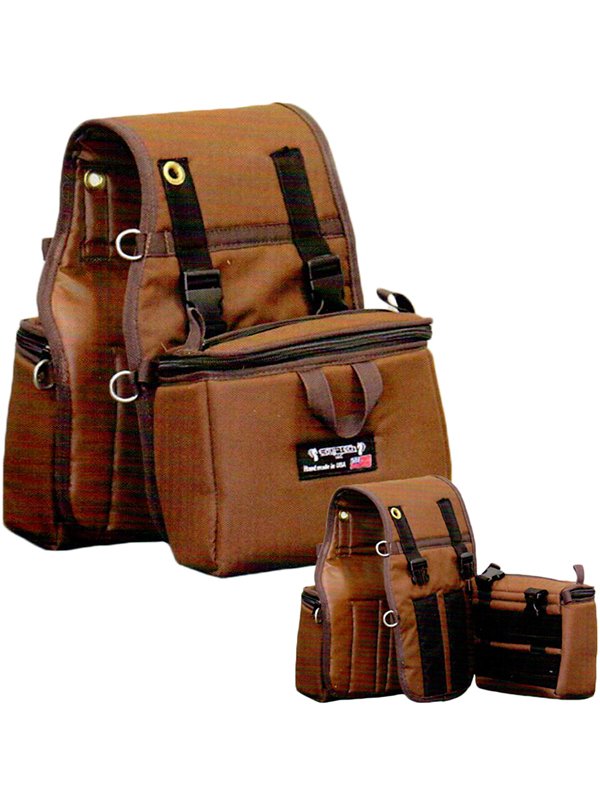
These saddle bags are made from heavy duty Cordura material with high density insulation to keep the heat out and the cold in. They’re designed with military grade snaps and heavy-duty Velcro to hold your bags in place and create a quick release system so you can remove each bag without removing the entire saddle bag setup.
They’re available in brown or black. Coolers measure 12″ x 9″ x 5″
Cashel Small Horn Bag
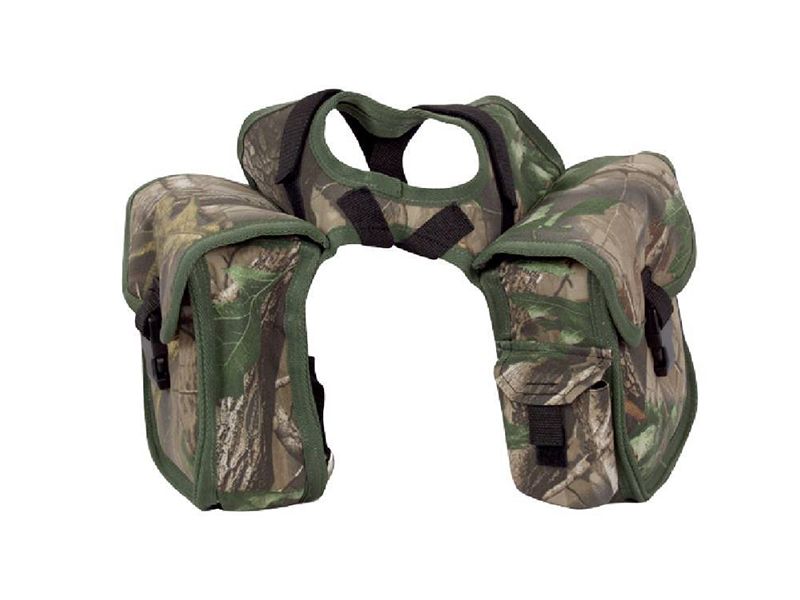
The Cashel Small Horn Bag is a great horse saddle bag if you’re just going on the trail for a couple of hours. This saddle bag is a very simple design. It adds a little extra storage space on your saddle so you can carry your camera, phone or other personal items.
It also doesn’t take up too much space or break your bank.
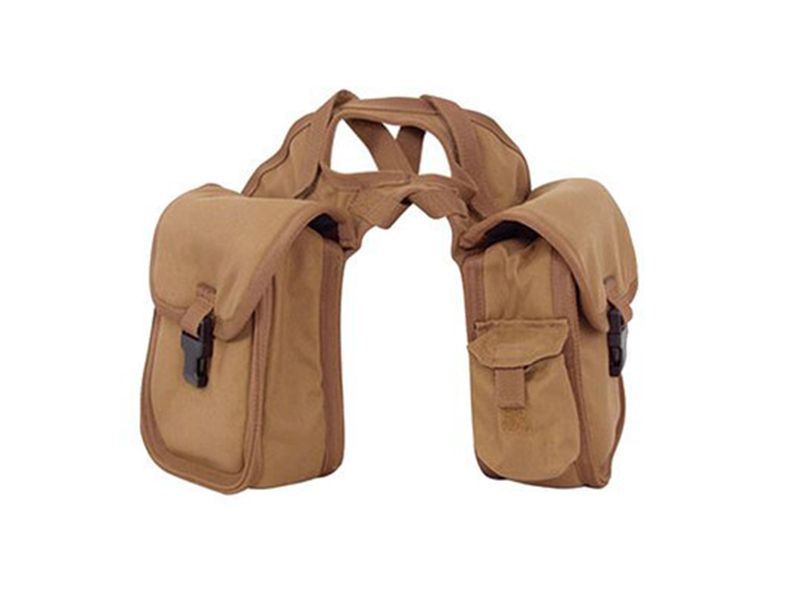
The Cashel Small Horn Bag is made with a large horn hole and is ideal for trail, ranch and other kinds of saddles. It also features buckled straps which will keep the bags out of your way.
They also won’t interfere with you mounting or dismounting. Nor, will they interfere with your riding in general.
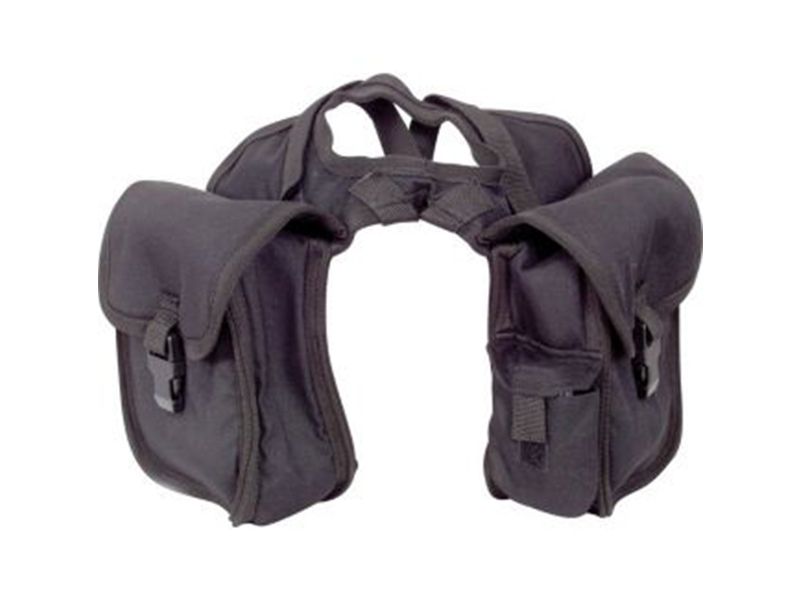
These horse saddle bags come in HotLeaf Camo (main image), Camo, Black or Brown. Measures 7″ W x 8″ H x 3.5″ D.
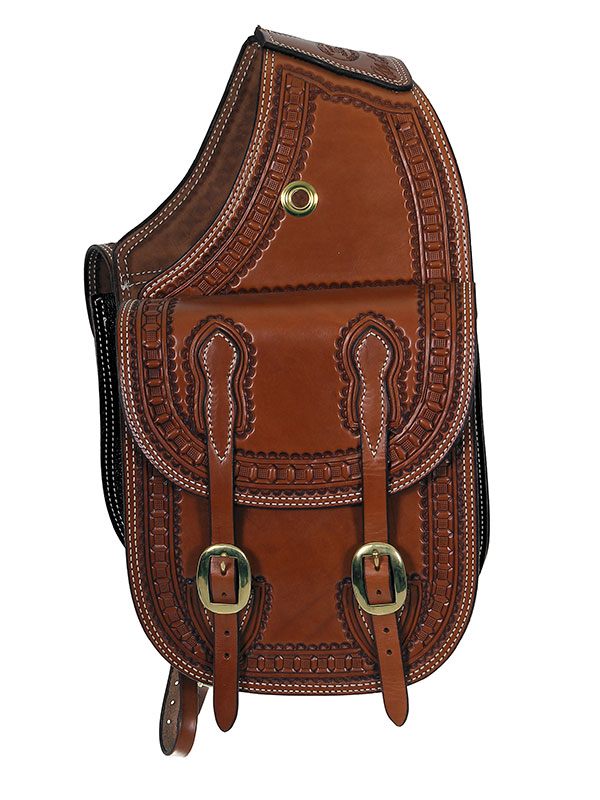
Billy Cook Basket Border Tooled Leather Saddle Bag 15-2734
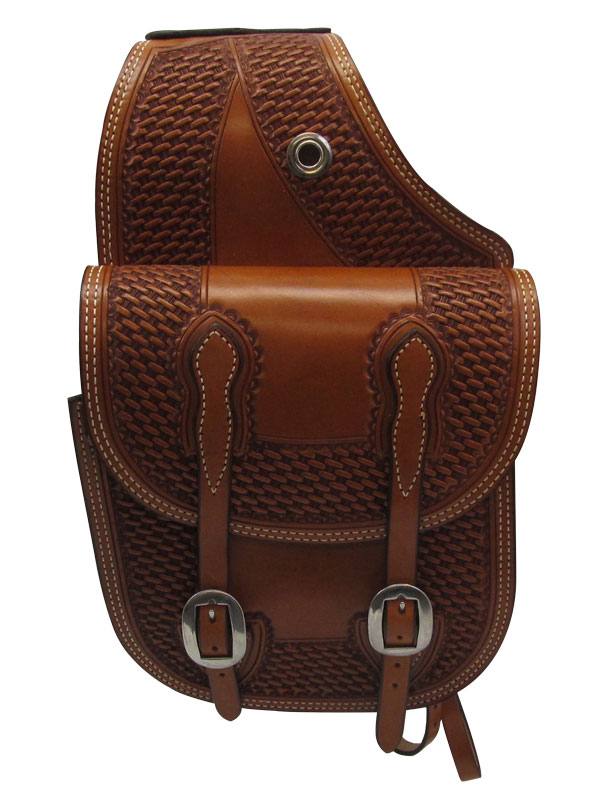
This is a more expensive saddle bag. It’s by Billy Cook and is made from good leather. They’re a little over 10″ x 10″ with an expansion 4″ thick but not insulated.
Here’s what you can fit in this particular saddle bag:
A Sandwich (10x10x4)
A bottle that is under 4″ diameter
A small medical kit under 10x10x 4
A bag of snacks under 10x10x4
Probably a small thin blanket folded up under 10x10x4
Cell phone, keys, wallet
This is good for very short day rides. Maybe a couple of hours. The reason this horse saddle bag is so expensive is because it’s made from leather and it’s hand tooled. Oh, and of course, the name – Billy Cook.
Tips for Using Your Horse Saddle Bags
Here are a few extra tips for using your horse saddle bags.
- Don’t overload your saddle bag. Remember, the more you pack into your saddle bags, the more weight your horse has to carry.
- Distribute the weight evenly. Horses walk better when weight is distributed evenly on their body.
- Put the heaviest item in your load on the bottom of the saddle bag. Then place the lighter items on top.
- Avoid packing too many heavy items over your horse’s kidneys.
- Place your saddle bag in the front of your horse’s center of gravity. Just behind their foreleg. That way, your horse can walk with ease.
I hope you enjoyed this post. Do you have questions about saddle bags? What’s your experience? I’d love to know. Post your comments below. And if you’d like to read some of my horse saddle reviews, head on over to my Circle Y Saddles Review.
Thank you for this amazing blog post. Horse riding passionates will find here all they need when purchasing their new horse saddle bag. One question though, how long is the longevity of such a leather horse bag? I am thinking about a gift, and want to be sure, it won’t be worn out soon. Thanks in advance
Hi Julius. Thanks for your question. Any item, if taken care of properly, will last a long time. That being said, I think, if you buy a leather saddle bag, and you take proper care if it, you have a good chance of having it for 25+ years or even a lifetime. So go ahead, buy this gift for that special someone. Happy holidays.
HI Shalisha! Your article reminds me of the western movies with John Wayne; my youth dreams are coming through. 🙂
I know only the classic leather saddlebags from the movies where you can put everything you need. It must be great to go for a trail for some days and sleep under the sky, watching the stars. We could do this in Ireland or Sweden, where you have much nature without seeing humans, but I can’t imagine going on a trail in the Netherlands. Maybe I need to find out, it would be a relaxed holiday, for sure.
If I think about the USA and the incredible nature, I would love to fly over and experience a trail of freedom and peace. Here in the Netherlands, we only ride for some hours and return the same day. If I go on a trail, I might buy classic leather bags, but nowadays, it is so easy to purchase lightweight materials that might be better for the horse. Leather is quite heavy, and you describe very well the other materials.
Your website is so beautiful that I feel motivated to ride again. I always have loved riding a horse. 🙂
Hi Sylvia. Thanks for visiting all the way from the Netherlands. It must be beautiful and exciting to ride on the trails over there! Going on trails overnight would require packing a lot more things though. I’m always concerned about the horse’s welfare, since they can’t speak for themselves when they’re in pain.
But there are saddlebags that are lightweight enough to go on overnight trails. It would be great to go at night and just lay out on the grass watching the stars. I’m glad my website motivates you to start riding again. Please come back anytime.
Hi Shalisha,
This is a great article on horse saddle bags and all the features and things to consider when buying them.
I wasn’t aware of the three types of saddle bags so that is really great to know. It’s been a few years since i’ve ridden a horse but this article makes me want to get back on the saddle!
Keep up the great work – very helpful to all readers.
Regards John
Hi John. Thanks for your feedback! Yes, saddle bags come in different shapes, sizes, material and colors. I hope you ride again soon and stop by again.
What a terrific idea if you often go on long rides and what a great range of saddlebags. I didn’t realize that they also come in cloth, waxed oilskin, and leather. I’ve always admired the leather saddlebags for western riding saddles but I can see how stiff they might be and heavy. Although, I would be concerned about the cloth bags bouncing around more if you cantered.
You’ve provided some great examples and I love Cordura saddle bags, attractive and practical too.
Hi Lily! Thanks for your feedback. Yes, leather saddle bags are very good looking, but they tend to be costly. Some are very rigid and some are soft. But the cloth material saddle bags are more flexible. As to your concern about the cloth bags bouncing around when cantering – our saddle bags are specifically made to avoid that. Flapping saddle bags will hurt the horse’s kidneys. Ouch! So we make ours with strings that securely attach to the saddle. You run them through the holes and then run them through the D ring. The key is to make sure you strap them down on both sides of the horse. Thanks again for stopping by, and come again.
I’ve always used a small backpack to put my water, raincoat, first-aid kit, snacks, etc. in when mustering cattle and sheep in the past. It wasn’t always comfortable or practical as the weight was higher up on my back. I can see that a better option would be to distribute the weight lower down on the horse’s back, and this would benefit both of us when navigating the hilly slopes.
The leather bags look quite rigid in comparison to the cloth and oilskin ones. So if durability is not a priority, I would probably go for the waterproof oilskin options.
Thanks for the information.
Hi Andrew. Thanks for your comment. I agree with you. The leather is not as flexible as the cloth. I think the leather is for show. Backpacks are not a good idea for riding a horse. As you said, it’s not comfortable for you and stops you from moving freely – especially if you have to act quickly. Also, the weight is distributed unevenly. I too would go for the waterproof oilskin options. I hope you stop by again soon.
Hi Shalisha,
Thanks for your extremely thorough post regarding hose saddlebags! Especially the tips, very practical and helpful!
The Cordura saddle bag looks of high quality and really sturdy. The price is good as well, to get a durable product that we can use for a long time. Hopefully, it will not take a long time to ship to New Zealand.
Cheers,
Grace
Hi Grace! Thanks for commenting all the way from New Zealand. It takes about 2 weeks to deliver one of our items to New Zealand. That’s pretty fast! The Cordura saddle bag is definitely high quality and sturdy. The price is definitely a great price at $127.95. Thanks again for stopping by. If there’s anything else I can help you with, let me know.
Can I take this bag anywhere I go? I have always wanted this kind of bag but never had the time to go and buy myself one. Thank God for online purchasing haha. I will be sure to place an order. How long do you think it would take for me to receive this bag?
Hi Daniel. I’m not sure where you live, but we ship worldwide. Actually, you can take this bag anywhere you go, or use it for something other than horse saddle riding. Heck, take it on a picnic with you. Good to hear from you!
Hi Shalisa, thank you for another great lesson well explained!
Is there a difference between the structured bags with panels or a softer waxed oilskin bag, other than the duration?
A used leather bag would seem to be the answer for me, it is much softer and looks more comfortable.
Hi Estelle. I hope I’m understanding your question. All saddle bags have a structure. They all have compartments. The cloth-made saddle bags and oilskin bags will have more bend to them – as opposed to the leather ones. If I misunderstood your question, please let me know. Thanks.
Some great tips and a good selection of saddle bags.
Regarding the saddles, I see there is a selection of Australian saddles. They are advertised with free shipping, does that include shipping to Australia?.
The Cordura bags look ideal for day rides and are well priced, but good leather work is hard to come by these days.
So wondering about a price for the leather saddle bags, and the used 13inch Down Under saddle including shipping?
If you could email me back please.
Hi Michael. Thanks for stopping by. Yes, we ship to Australia! Shipping to Australia is not free but we charge a reduced rate. We do not carry down under saddle bags. The leather Billy Cook saddle bag has been discounted from $497.76 to $414.80.
I always thought that the only saddle bags were the paired ones, which are still my favorites. I’m not sure about the Cantle bag, because when you mentioned that it is positioned over the horse’s kidneys I wouldn’t like to put anything over there. I wouldn’t want to overload it either, but just take the essentials, like the list that you mentioned.
The Cashel Small Horn bag may be small but I like the design and color.
Hi Christine. Thanks for your comment. I like the paired ones myself. I’m not a fan of the cantle bag either. I’m very sensitive to the horse’s wellbeing. I think people forget to just take the essentials and end up overloading the poor horse. I love the Cashel Small Horn bag in brown. They’re beautiful saddle bags. Thanks for stopping by!
My cousin is going to eat this UP! Forwarding this to him now. Thanks so much for this, we were just talking about this and it’s right up his alley. Great post!
Thanks Eric! I’m sure your cousin is going to find a lot of great saddles on here.